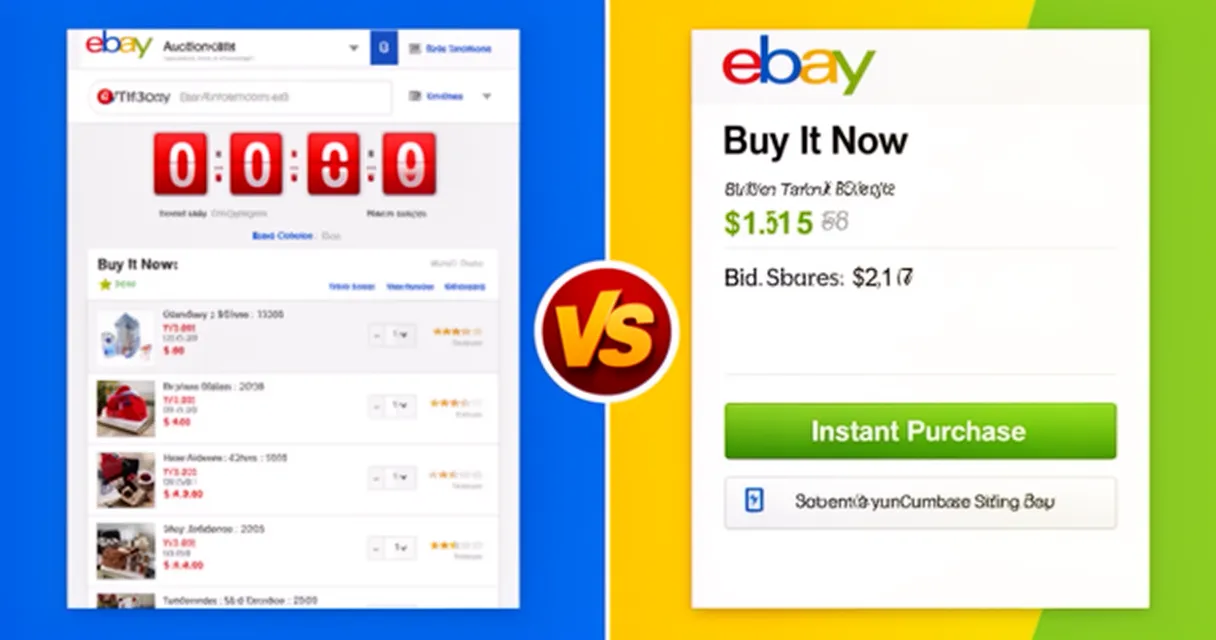
You listed the same item twice — one as auction, one as Buy It Now — and the results were completely different. Sound familiar?
Most eBay sellers pick a listing format out of habit or guesswork, costing them sales velocity, profit margin, or both. You might default to auctions because “that’s how eBay works,” or you might slap a fixed price on everything without thinking twice. Either way, you’re probably leaving money on the table.
This guide breaks down exactly when each format wins, how the fees and buyer behavior differ, and gives you a simple decision framework so you never have to guess again. Whether you’re clearing out a closet or running a full-time reselling business, the format you choose directly affects your bottom line.
Here’s the quick answer: Buy It Now is the right default for most resellers. It accounts for roughly 88% of all eBay listings (ZIK Analytics/Thunderbit 2026), offers more consistent cash flow, and matches modern buyer preferences. Auctions outperform only for rare, highly sought-after, or difficult-to-price items.
Now let’s dig into the details so you can make the right call every time. If you’re newer to the platform, our Ultimate Guide to Selling on eBay covers the fundamentals before you dive into format strategy.
What Is the Difference Between eBay Auction and Buy It Now?
At its core, the difference comes down to who sets the final price — you or the market.
Auction-style listings let buyers bid on your item over a set period (1, 3, 5, 7, or 10 days). The listing starts at a price you choose, and buyers compete to outbid each other. When the clock runs out, the highest bidder wins. You can set a reserve price to protect yourself from selling too low, but the final sale price is ultimately determined by buyer demand.
Buy It Now (fixed price) listings let you set an exact price. Buyers pay that price immediately and the transaction is done. There’s no waiting, no bidding war, and no uncertainty. You can run these listings with a 30-day duration (or Good ‘Til Cancelled), and eBay automatically renews them each month.
The hybrid option — which we’ll cover in detail below — lets you combine both formats on a single listing.
With roughly 2.3 billion live listings worldwide (eBay Fast Facts / Red Stag Fulfillment 2026), eBay’s marketplace is enormous. Understanding how each format functions within that ecosystem is critical to your eBay listing format strategy.
How the Hybrid “Add Buy It Now to an Auction” Option Works
eBay lets you add a Buy It Now price to an auction listing, giving buyers a choice: bid and potentially get a deal, or pay the fixed price and secure the item immediately.
Here’s how it works in practice:
- You create an auction listing with a starting bid (e.g., $50).
- You add a Buy It Now price (e.g., $120).
- The BIN option disappears once a bid is placed (unless you also set a reserve price, in which case BIN stays visible until the reserve is met).
- If someone clicks Buy It Now before any bids come in, they pay the fixed price and the auction ends.
This hybrid approach works well when you have a general sense of an item’s value but want to test demand. It gives impatient buyers an instant-purchase option while still allowing the market to compete if they choose to bid.
Pro tip: Use AI-powered pricing tools like Terapeak or third-party analytics platforms to research sold comps before setting your BIN price on hybrid listings. These tools can scan thousands of completed sales in seconds and suggest an optimal price range.
When eBay Auctions Work Best
Auctions aren’t dead — they’re just situational. Here are the scenarios where auction-style listings genuinely outperform fixed price.
Rare and collectible items. Vintage watches, first-edition books, signed memorabilia, rare trading cards — when buyers can’t easily find an item elsewhere, competition drives prices up. An auction creates urgency and lets the market determine fair value.
Limited editions and one-of-a-kind pieces. If you have something unique, an auction generates excitement. Collectors follow these listings, set alerts, and snipe bids in the final seconds. That bidding frenzy can push the final price well above what you’d set as a fixed price.
Items you can’t confidently price. Found a weird vintage gadget at an estate sale? No sold comps on eBay? An auction lets the market tell you what it’s worth instead of you guessing wrong and either leaving money on the table or scaring buyers away.
Liquidation and fast clearance. When you need to move inventory quickly — seasonal items after the holiday, overstock, or items that have been sitting for months — a 7-day auction starting at $0.99 can generate interest and clear space in your storage.
The Risk Side of Auctions: What Can Go Wrong
Auctions sound exciting, but they carry real risks that every seller should understand.
- Low sell-through at disappointing prices. If your item doesn’t attract enough eyeballs, you might sell a $100 item for $12. Starting bids at $0.99 only work when demand exists.
- Timing dependency. Auction end times matter enormously. An auction ending at 3 AM on a Tuesday will get fewer bids than one ending at 8 PM on a Sunday. You’re at the mercy of the clock.
- Reserve price fees. If you set a reserve price to protect yourself, eBay charges a fee of $5 or 7.5% of the reserve price (whichever is greater), up to a maximum of $250 (eBay Seller Fees Help Page 2025). If the item doesn’t sell, you don’t get that fee back.
- Single-quantity limitation. Auctions only allow one item per listing. If you have 20 units of the same product, you’d need 20 separate auction listings — a logistical headache.
- Buyer experience friction. Many modern buyers don’t want to wait 7 days and risk losing a bidding war. They want to click, pay, and move on.
When Buy It Now (Fixed Price) Works Best
For the vast majority of items and sellers, Buy It Now is the superior format. Here’s why.
Common, easily sourced items. If your item has dozens of other sellers offering the same thing, an auction won’t drive competitive bidding. Buyers will just purchase from whoever has it at a fair fixed price right now.
High-volume sellers. If you list 50+ items per week, managing auction timing, monitoring bids, and dealing with unpredictable revenue is unsustainable. Fixed price listings with Good ‘Til Cancelled duration automate the process.
Cross-listed inventory. If you cross-list your items across platforms like Poshmark, Mercari, or your own Shopify store, fixed price is the only format that works. You can’t have an active auction on eBay while the same item is listed elsewhere — it creates fulfillment nightmares.
Items with well-established market values. When Terapeak or AI-driven analytics tools show you that an item consistently sells for $45-$50, there’s no reason to auction it. List it at $49.99 with Best Offer enabled and move on.
Why Most eBay Sellers Have Switched to Fixed Price
The numbers tell the story: approximately 88% of all eBay listings are now Buy It Now (ZIK Analytics/Thunderbit 2026). That’s not a coincidence — it reflects a fundamental shift in both buyer and seller behavior.
Here’s what’s driving this trend:
- Buyer expectations have changed. Amazon trained an entire generation to expect instant purchasing. eBay buyers now prefer the same experience. Waiting 7 days to maybe win an auction feels outdated.
- Predictable cash flow. With fixed price, you know exactly what you’ll earn per sale. That predictability is essential for resellers managing inventory costs, shipping costs that affect your net profit, and reinvestment budgets.
- Better search visibility. eBay’s Cassini search algorithm tends to favor listings with strong sell-through rates and buyer satisfaction metrics. Fixed price listings with competitive pricing often rank better in search results.
- Scalability. Multi-quantity fixed price listings let you sell 100 units from a single listing. Auctions require one listing per unit.
- Best Offer flexibility. Buy It Now listings let you enable Best Offer, which creates a negotiation dynamic similar to auctions but without the time constraint or unpredictability.
eBay Auction vs Buy It Now: Fee Comparison
One of the most common questions sellers ask about eBay auction vs buy it now is whether one format is cheaper. The short answer: they’re almost identical in core fees, with a few important exceptions.
| Fee Type | Auction | Buy It Now (Fixed Price) |
|---|---|---|
| Insertion fee | Free for first 250/month, then $0.35 | Free for first 250/month, then $0.35 |
| Final value fee (FVF) | 13.25% (most categories) + $0.30 | 13.25% (most categories) + $0.30 |
| Reserve price fee | $5 or 7.5% of reserve (max $250) | N/A |
| Promoted listings | Available (less common) | Available (widely used) |
| Store subscription discount | Yes | Yes |
| International fee | 1.65% additional | 1.65% additional |
Key takeaway: The final value fee percentage is the same regardless of format. The main fee difference is the reserve price fee that only applies to auctions. If you set a reserve and the item doesn’t sell, you still pay that fee — it’s a sunk cost that fixed price sellers never incur.
Also consider the indirect costs. Auctions that end without bids waste your time. Relisting costs add up if you need multiple auction cycles to sell an item. With fixed price, a single Good ‘Til Cancelled listing keeps running until it sells — no relisting needed.
A Simple Decision Framework: Which Format Should You Choose?
Instead of guessing, run through this 4-step framework every time you list an item. It takes 60 seconds and will save you from costly format mistakes.
Step 1: Check sold comps. Search eBay’s completed listings (or use AI-powered tools like Terapeak) for your item. Do you see a consistent price range? If yes, go to Step 2. If no (prices are wildly inconsistent or there are very few comps), consider an auction.
Step 2: Assess supply and demand. Are there many active listings for the same item? If supply is high, use Buy It Now at a competitive price. If supply is low and demand appears high (lots of watchers, frequent sales), an auction may drive the price up.
Step 3: Evaluate urgency. Do you need to sell this item quickly? Buy It Now sells faster on average. Are you willing to wait and gamble on a higher return? An auction might deliver — or it might not.
Step 4: Consider your volume. Are you listing more than 20 items per week? Default to Buy It Now for efficiency. Auctions demand individual attention that doesn’t scale.
The bottom line: If you went through all four steps and you’re still unsure, choose Buy It Now with Best Offer enabled. It’s the safest, most scalable, most buyer-friendly option.
Category Quick Reference: Auction vs Buy It Now by Item Type
Use this table as a quick cheat sheet when deciding how to list specific types of inventory:
| Item Category | Recommended Format | Why |
|---|---|---|
| Vintage clothing (rare, branded) | Auction | Scarcity drives bidding wars |
| Common clothing (mall brands) | Buy It Now | High supply, price-sensitive buyers |
| Trading cards (graded, rare) | Auction | Collectors compete aggressively |
| Trading cards (common, ungraded) | Buy It Now | Low individual value, high volume |
| Electronics (new, sealed) | Buy It Now | Established market prices |
| Electronics (vintage, rare) | Auction | Hard to price, collector interest |
| Books (first editions, signed) | Auction | Unique items attract competitive bids |
| Books (common titles) | Buy It Now | Consistent pricing, fast turnover |
| Home goods & decor | Buy It Now | Buyers want instant purchase |
| Coins & stamps | Auction | Established collector auction culture |
| Sneakers (limited release) | Auction or Hybrid | Hype-driven demand, volatile pricing |
| Sneakers (general release) | Buy It Now | Known market value, high competition |
How to Maximize Revenue Regardless of Which Format You Choose
Your listing format matters, but it’s not the only lever you can pull. Here are proven tactics that boost revenue no matter which format you select.
Optimize your titles for search. Use all 80 characters. Include the brand, model, size, color, condition, and key descriptors. eBay’s search algorithm matches buyer queries to your title — don’t waste a single character. AI listing tools can analyze top-performing titles in your category and suggest optimized variations.
Invest in quality photos. Listings with clear, well-lit photos on a clean background sell faster and for higher prices. Use all 24 photo slots if you can. Show every angle, any flaws, and include measurements where relevant.
Fill out item specifics completely. eBay uses item specifics to filter search results and match your listing to buyers. Missing specifics means missing visibility. Learn how to optimize your eBay item specifics to appear in more filtered searches.
Enable Best Offer on fixed price listings. This gives price-sensitive buyers a way to negotiate without the unpredictability of auctions. Set auto-accept and auto-decline thresholds so you don’t have to manually review every offer. AI-powered repricing tools can automatically adjust your Best Offer thresholds based on market conditions and inventory age.
Use promoted listings strategically. eBay’s promoted listings program boosts your item’s visibility in search results. For high-margin items, a 2-5% promoted listing fee can dramatically increase exposure and sell-through rate.
Time your listings thoughtfully. For auctions, end them on Sunday evenings when buyer activity peaks. For Buy It Now, list during high-traffic periods so your “newly listed” boost aligns with maximum eyeballs.
Write compelling descriptions. Don’t just list specs — tell the buyer why this item matters. Address common objections, highlight condition details, and include relevant keywords naturally.
Frequently Asked Questions
When should I use an auction instead of Buy It Now on eBay?
Use an auction when you have a rare, collectible, or hard-to-price item where competitive bidding is likely to drive the price above what you could set as a fixed price. Auctions work best for one-of-a-kind items, vintage collectibles, limited editions, and situations where sold comp data is sparse or highly variable. If you can’t confidently determine the market value, letting bidders decide through an auction is a smart strategy. For everything else, Buy It Now with Best Offer enabled is typically the better choice.
Does Buy It Now or auction sell faster on eBay?
Buy It Now sells faster in the vast majority of cases. A fixed price listing can result in an immediate sale the moment a buyer finds your item, whereas an auction forces buyers to wait until the listing ends (1-10 days). Buy It Now also eliminates the risk of an auction ending with zero bids, which would require relisting and further delays. The only exception is a hot auction for an in-demand item, which can create urgency that drives a quick sale at the auction’s end.
Why do most eBay sellers use Buy It Now instead of auctions?
Approximately 88% of eBay listings are now Buy It Now because the format better matches modern buyer expectations, provides predictable revenue, and scales more efficiently. Buyers increasingly prefer instant purchasing over waiting for an auction to end. Sellers prefer the consistent cash flow, the ability to list multiple quantities on a single listing, and the compatibility with cross-platform selling. The shift also reflects eBay’s own strategic push toward a fixed-price marketplace experience.
What are the fees for eBay auctions compared to Buy It Now?
The core fees are nearly identical. Both formats charge the same final value fee (13.25% in most categories plus $0.30 per order) and the same insertion fees (free for the first 250 listings per month, then $0.35 each). The key difference is the reserve price fee for auctions: if you set a reserve, eBay charges $5 or 7.5% of the reserve amount (whichever is greater), up to $250. This fee applies whether or not the item sells. Buy It Now listings never incur this extra cost.
Can I offer both auction and Buy It Now on the same eBay listing?
Yes. eBay allows you to add a Buy It Now price to an auction-style listing. This gives buyers the option to either place a bid or purchase immediately at your set price. The Buy It Now option disappears once the first bid is placed, unless you have also set a reserve price — in that case, the Buy It Now option remains visible until the reserve is met. This hybrid format works well for items where you have a target price but want to give the market a chance to exceed it.
Which listing format gets more views on eBay?
Neither format inherently gets more views — visibility depends on your title optimization, item specifics, pricing competitiveness, and seller metrics, not the listing format itself. That said, Buy It Now listings tend to perform better in search because they align with eBay’s Cassini algorithm preferences for buyer satisfaction and conversion rate. Auctions can get a temporary visibility spike as they approach their end time, but this is inconsistent. For sustained, reliable visibility, a well-optimized Buy It Now listing with promoted listings enabled is your best bet.
Conclusion
Choosing between eBay auction vs buy it now doesn’t have to be a guessing game. The data is clear: Buy It Now is the right default for most sellers and most items. It sells faster, scales better, provides predictable income, and matches what today’s buyers expect.
But auctions still have their place. When you’re sitting on something rare, collectible, or genuinely hard to price, an auction can unlock value that a fixed price never would. The key is knowing which situations call for which format — and now you have a framework to make that call confidently.
Here’s your action plan:
- Audit your current listings. Are any items sitting unsold in the wrong format? Switch them.
- Apply the 4-step framework to every new listing going forward.
- Enable Best Offer on all your Buy It Now listings for built-in negotiation.
- Use AI-powered analytics tools to research comps and optimize pricing before you list.
- Revisit your strategy quarterly. Markets shift, categories evolve, and your format strategy should evolve with them.
Ready to level up your entire eBay selling operation? Start with our Ultimate Guide to Selling on eBay for a complete walkthrough from setup to scaling.